Prayer · · 4 min read
How to Pray Salah at Home: A Simple Setup for US Homes
To pray at home, choose a clean, quiet spot, find the qibla (northeast from anywhere in the US), lay a prayer rug with its arched end toward it, and keep the space ready so you can start salah without setting up each time. A few small choices make the five daily prayers easier to keep, even in a small apartment.
Below is a practical setup that works in most American homes, from a studio apartment in New York to a family house in Texas.
1. Pick the right spot
You do not need a whole room. You need a space about 3 feet wide and 5 feet long that is:
- Clean. Salah must be prayed on a clean place. Avoid spots where shoes walk all day.
- Quiet and low-traffic. A bedroom corner or the end of a hallway often works better than the middle of the living room.
- Free of distractions in front of you. A blank wall or a window toward the qibla helps focus. Avoid praying facing a TV or a mirror if you can.
If you live with family or roommates, agree on one spot so nobody walks in front of you while you pray.
2. Find the qibla once, then mark it
From the United States the qibla points northeast, along the shortest path over the globe to Makkah. The exact angle depends on your city: about 58° from true north in New York City, 49° in Chicago, 46° in Houston and 24° in Los Angeles. Our qibla direction table for 20 US cities lists the bearing for each.
Use a qibla app that corrects for magnetic north, turn to the bearing, and note a landmark such as a window corner. Once you know it, you never have to check again in that room.
3. Choose a prayer rug for your floor
Most US homes have hardwood, tile or laminate floors. A thin rug on a hard floor is fine for a few minutes, but five prayers a day adds up on the knees and forehead.
| Your floor | What works best |
|---|---|
| Wall-to-wall carpet | A thin or medium prayer rug is enough |
| Hardwood or laminate | A foam-padded rug with a non-slip back |
| Tile or concrete | A thick rug, about 3 inches of padding |
| Shared or small space | A rug you can fold and store easily |
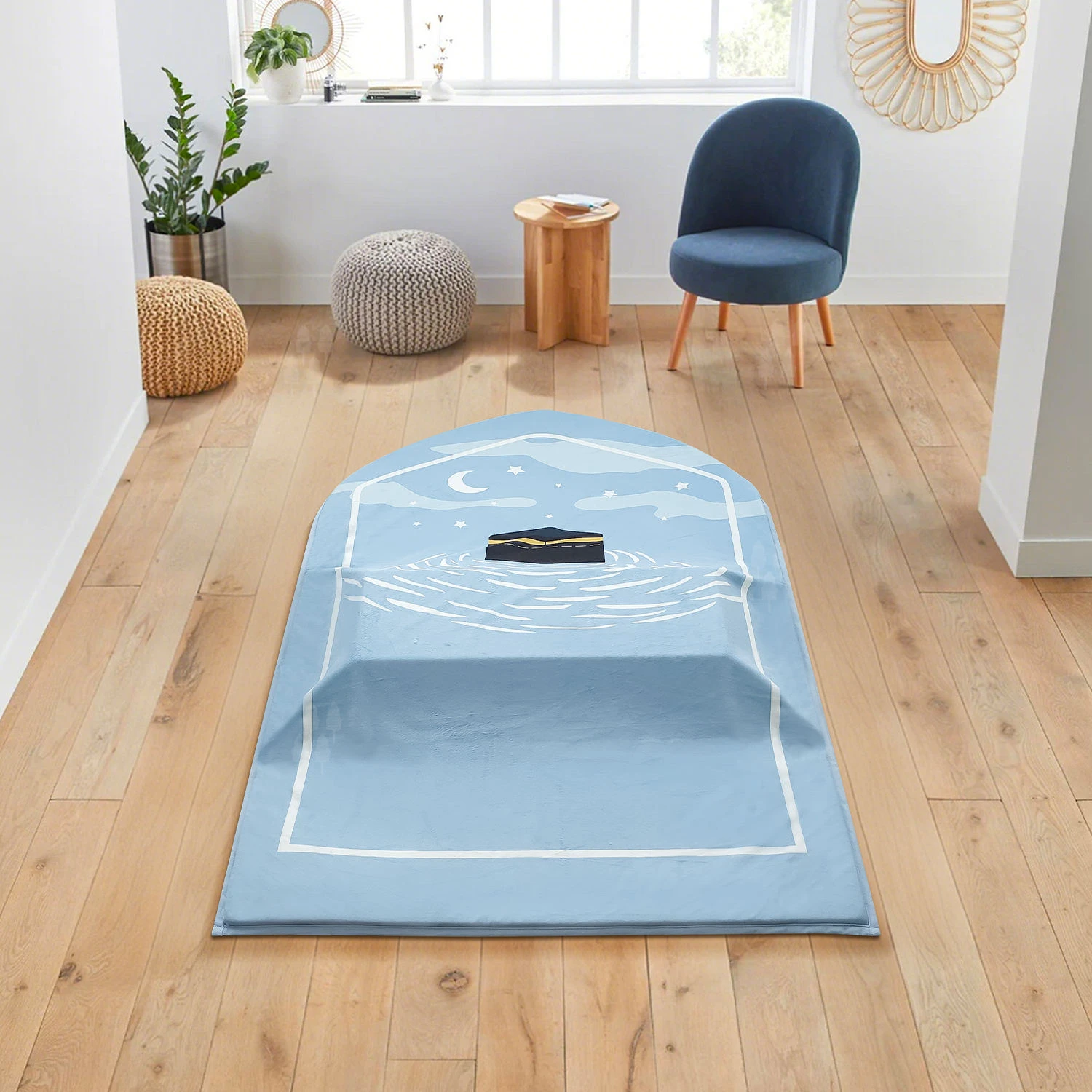
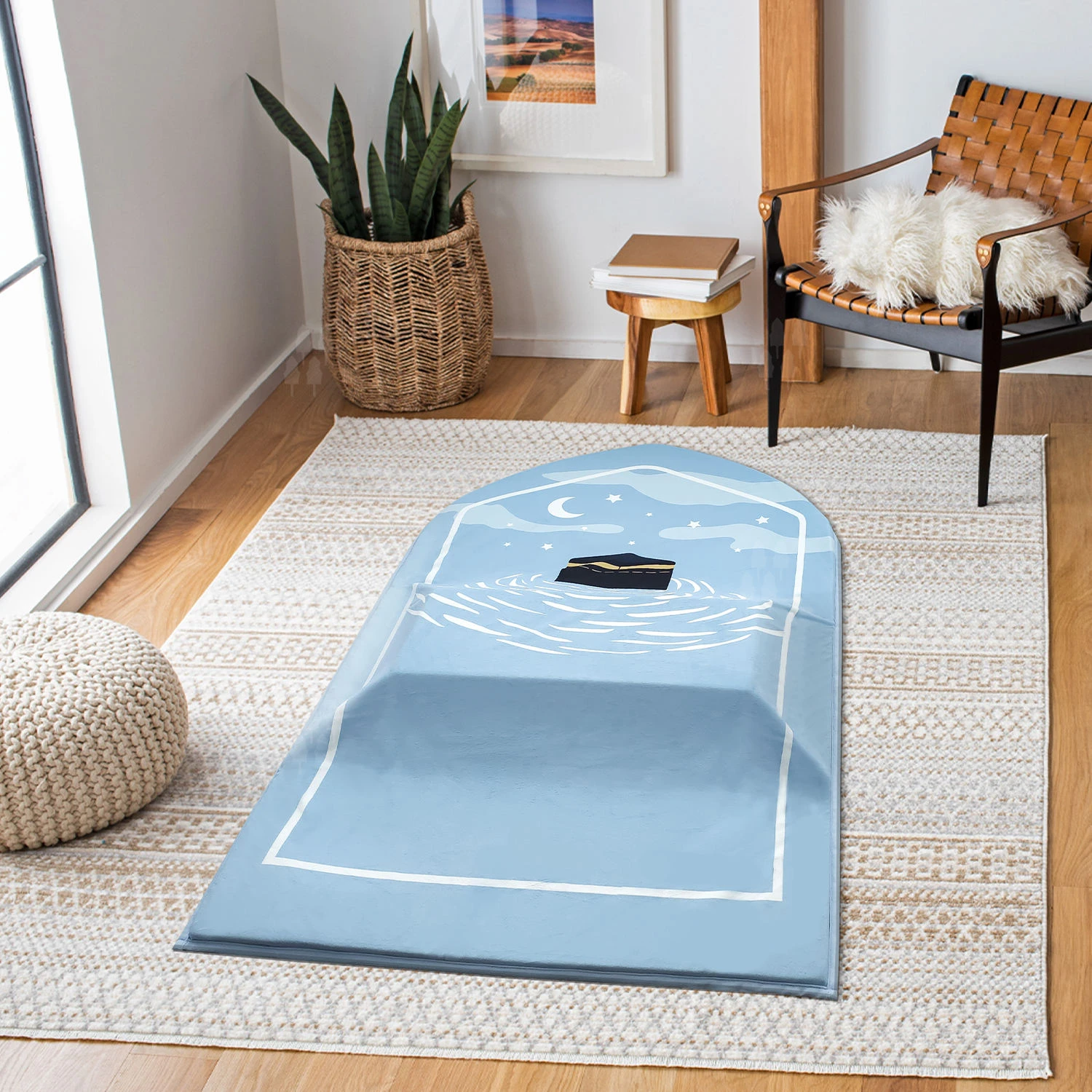
Our Mihrab Garden thick prayer rug has about 3 inches of padding and a non-slip back for tile and wood. The memory foam prayer rug puts a raised cushion exactly where your knees and forehead rest. For more on sizes and types, see our prayer rug guide.
4. Keep what you need within reach
A simple prayer corner might hold:
- your prayer rug, laid out or folded on a low shelf
- a clean scarf or prayer clothes on a hook
- a small Quran on a stand, kept off the floor
- a tasbih for dhikr after salah
- a soft lamp for Fajr and Isha, so you do not need bright overhead lights
Keep the space simple. Fewer objects means fewer distractions.
5. Build a routine around the five prayers
Prayer times change through the year, especially in northern states where summer Isha is late and winter Fajr is dark and cold. A few habits help:
- Use a prayer time app set to your city and the calculation method your local masjid follows.
- Pair each prayer with something you already do: Fajr before coffee, Dhuhr before lunch, Maghrib before dinner.
- Leave the rug out if you can. Removing the setup step removes an excuse.
- Pray together with family when possible, even one prayer a day.
6. Make it comfortable for everyone in the family
Children can have their own small rug next to yours, which makes salah feel like something the family does together. Older parents may need more padding, or a chair if kneeling is hard; our guide to the best prayer rug for elderly parents covers both.
FAQ
Can I pray anywhere in my house?
Yes, as long as the place is clean and you face the qibla. Many scholars discourage praying in the bathroom; any other clean room is fine.
Do I need a prayer rug to pray at home?
No. Any clean surface is valid for salah. A prayer rug simply makes it easy to know your spot is clean and adds comfort on hard floors.
Which direction should I face when praying in the US?
Northeast. The exact bearing depends on your city, for example about 58° from true north in New York City and 24° in Los Angeles.
A softer place for sujood
Thick prayer rugs from $39, shipped across the USA in 1–2 business days.